
Spring 2026 Night Hiking Safety: What You Need on Canada’s Mud Season Trails
Daylight Saving Time begins on March 8, 2026. For most Canadians, that means an extra hour of evening light. For trail hikers, it means something else: the temptation to push deeper into terrain that’s still frozen, flooded, or coated in black ice.
Temperatures swing between freeze and thaw during Canada’s “Mud Season.” The Bruce Trail in Ontario, the trails of Banff and Jasper in the Rockies, and trails across British Columbia all face the same hazards: deep mud that looks like solid ground, ice that looks like wet rock, and fast-fading light at dusk.
A cheap flashlight won’t cut it here. What you actually need is listed below.
Why Cheap Lights Fail on Spring Trails
Budget flashlights typically produce a single, narrow beam. That beam casts sharp shadows at the edges—exactly where mud holes and ice patches hide. Without proper peripheral illumination, your brain fills in the gaps with assumptions. On a dry summer trail, that’s acceptable. On a spring trail after dusk, it leads to twisted ankles, falls, or worse.
According to Trail Canada, slip-and-fall injuries spike during March and April, with low-light conditions listed as a contributing factor in the majority of incidents. Quality lighting isn’t a luxury on spring trails—it’s safety equipment.
Beam Profile Explained: Flood vs. Throw
When you look at headlamp specs, you’ll see two beam types: flood and throw. Understanding the difference is the first step toward choosing the right light for muddy terrain.
Flood Beam: Your Peripheral Safety Net
A flood beam spreads light wide. It illuminates a broad area around your feet and the immediate terrain, giving you the peripheral vision to spot terrain changes before you step into them. On a muddy trail, the flood beam shows you the width of the puddle, the edge of the icy patch, and the root across your path.
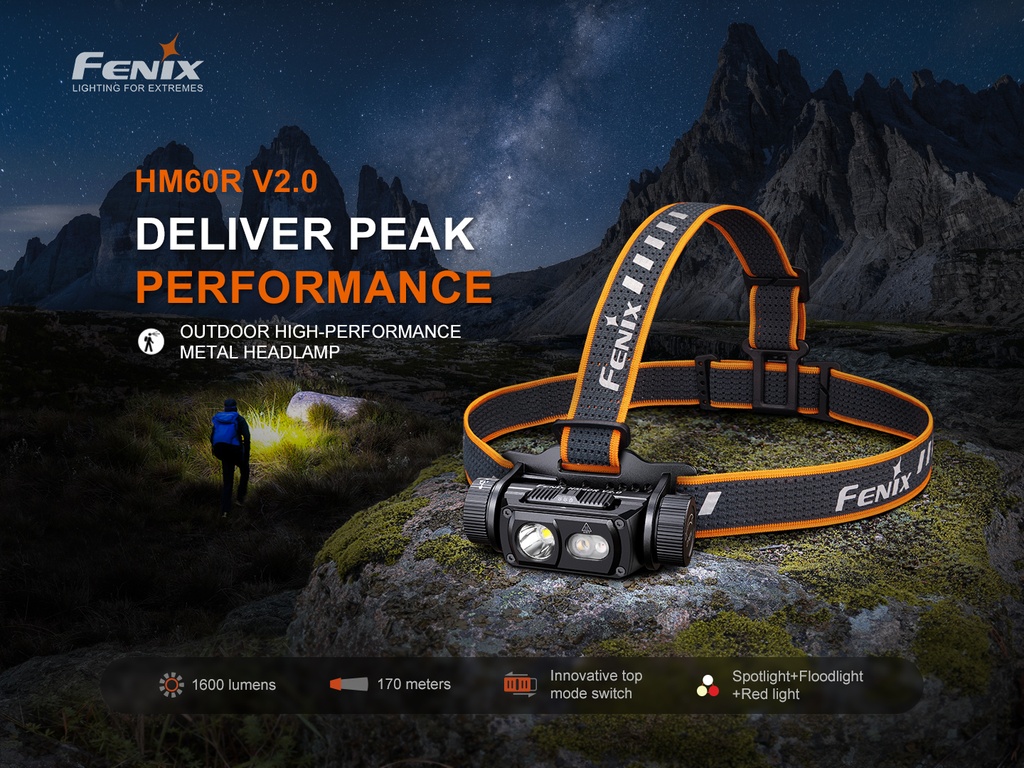
The Fenix HM60R V2.0 combines a spotlight, floodlight, and red light in one headlamp, delivering 1,600 lumens. The dual-beam design is built precisely for this kind of varied terrain—a practical choice for anyone hitting the Bruce Trail or Alberta foothills this spring.
Throw Beam: Spotting Trail Markers at Distance
A throw beam focuses light into a tight, long-range column. You need this to spot trail blazes on trees, cairns on rocky switchbacks, and fork signs before you reach them. In spring, trails are often obscured by fallen branches, snow melt, or overgrowth. Throw lets you plan your next 50 to 100 metres.
The Fenix HP35R headlamp delivers 4,000 lumens at a throw distance of 450 metres. That reach is well beyond what any spring trail in Canada demands, which means you always have excess capacity when trail conditions deteriorate.

Why High CRI Matters on Muddy Terrain
CRI stands for Colour Rendering Index—it measures how accurately a light source shows the true colour of objects, on a scale from 0 to 100. Standard LED flashlights often run at CRI 65 to 70. High-CRI lights operate at CRI 90 or above.
On a spring trail, the difference is critical. Wet mud, black ice, standing water, and solid ground can all look identical under a low-CRI beam. A high-CRI beam separates these surfaces by revealing subtle colour and texture differences. You see the sheen on ice. You see the darker saturation of deep mud. Your depth perception becomes more reliable.
Outdoor safety researchers note that colour-accurate lighting reduces misstep rates in low-contrast terrain by improving surface discrimination. Mud Season in Canada is exactly that kind of terrain.
IP68 and Impact Resistance: Built for Spring Conditions
Spring hiking in Canada means rain, slush, stream crossings, and the occasional drop onto wet rock. Your light needs to survive all of it.
IP68 is the highest standard rating for dust and water resistance. A light rated IP68 withstands submersion in up to 2 metres of water for 30 minutes—covering stream crossings, sudden downpours, and drops into puddles.
Impact resistance ratings (typically tested at 1 metre or more) protect the lens and housing from trail drops. Fenix lights are tested to MIL-STD-810 impact standards, exceeding standard consumer gear by a significant margin.
The Fenix HL45R headlamp carries an IP68 rating and 1,000 lumens in a lightweight form factor—a strong candidate for day hikes that push into dusk on wet terrain.

Compact Backup Flashlights for Your Trail Pack
A headlamp is your primary light source on the trail, but spring hiking adds one more risk: gear failure. Wet conditions, a dead battery at dusk, or a dropped headlamp in a stream crossing can leave you in the dark on a trail that’s far less forgiving in March than in July.
Carrying a compact, IP68-rated flashlight in your pack costs almost no weight and solves the backup problem completely. These two options from Fenix Tactical Canada are small enough to forget about until you need them, and capable enough to get you safely off the trail.
Fenix LD30R: Lightweight Power with a Backpack Clip

The Fenix LD30R is a compact outdoor flashlight built around a single 18650 rechargeable battery. It delivers 1,700 lumens at a beam distance of 267 metres and charges via USB-C, so it works off a power bank in your pack. The two-way body clip attaches directly to a backpack strap or hip belt, keeping it accessible without adding bulk.
IP68 waterproof rated with dual switches: a tail switch for on/off control and a side button to cycle through five brightness levels plus SOS and strobe. The LD30R gives you primary-light output in a secondary-light package. If your headlamp fails mid-trail, this pulls full duty without hesitation.
Fenix PD25R: Ultra-Compact with MOLLE and Belt Carry

The Fenix PD25R is one of the smallest capable trail flashlights available. It runs on a single 16340 rechargeable battery (or a CR123A as a field alternative) and produces 800 lumens at 250 metres. The entire unit fits in a jacket pocket or clips to any MOLLE-compatible gear, backpack strap, or belt.
Like the LD30R, it carries an IP68 rating and uses USB-C charging. The tactical tail switch gives you momentary-on for quick terrain checks without committing to a full lighting mode. The CR123A battery compatibility matters specifically for spring hiking—cold temperatures above treeline or in the Rockies drain lithium-ion batteries faster than expected, and a disposable CR123A serves as insurance.
Recommended Fenix Lights for Spring Trail Hiking
These five lights from Fenix Tactical Canada cover every spring hiking scenario, from primary headlamps to compact backpack backups:
- Fenix HM60R V2.0 (1,600 lm, IP68, dual beam): Primary headlamp for hikers who need flood and throw in one unit on trails like the Bruce Trail.
- Fenix HP35R (4,000 lm, 450 m throw, IP68): Primary headlamp for overnight or multi-day routes in the Rockies where long-range trail spotting is critical.
- Fenix HL45R (1,000 lm, IP68, lightweight): Primary headlamp for moderate day hikes that push into dusk.
- Fenix LD30R (1,700 lm, IP68, backpack clip): Compact backup flashlight with primary-light output for any trail pack.
- Fenix PD25R (800 lm, IP68, ultra-compact, CR123A compatible): Smallest capable trail backup; fits any pocket or MOLLE strap.
FAQ: Night Hiking Safety in Canada
What is the best headlamp for spring trails in Canada?
Look for a headlamp with both flood and throw beam modes, an IP68 waterproof rating, and at least 1,000 lumens. The Fenix HM60R V2.0 fits all three criteria and is well-suited to wet spring conditions.
How do I spot black ice on a trail at night?
A high-CRI light (CRI 90+) reveals the subtle surface differences between ice, wet rock, and mud by rendering colour accurately. Pair it with a flood beam to light the terrain near your feet.
What does IP68 mean for a hiking flashlight?
IP68 means the light is protected from dust and can be submerged in water up to 2 metres deep for 30 minutes. For spring hiking in Canada, this covers stream crossings, rain, and slush without damaging the unit.
Should I carry a backup flashlight on a day hike?
Absolutely. A compact flashlight like the Fenix PD25R or Fenix LD30R adds minimal weight and gives you a full working light if your headlamp fails. Spring conditions increase the risk of gear failure from moisture and cold.
How many lumens do I need for hiking at night?
For most hiking trails, 500 to 1,000 lumens on flood mode is adequate. For remote or technical terrain, go to 1,500 lumens or above. Spring trails with mud and ice benefit from higher output because accurate surface reading requires good light intensity.
What is the difference between flood and throw on a headlamp?
Flood spreads light wide over a short range. Throw concentrates light into a narrow beam over a long range. Spring hikers need both: flood for the ground near your feet and throw for spotting trail markers ahead.
Gear Up Before You Hit the Trail
Mud Season doesn’t wait. Canadian trails are already opening as temperatures rise, and the first hikers out face the worst terrain of the year. A premium headlamp paired with a compact backup flashlight from Fenix Tactical Canada is the most effective safety upgrade you can make before your first spring hike.
Browse the full headlamp collection at Fenix Tactical Canada and find the right light for your spring 2026 trail season. Same-day shipping available across Canada.